Structural Tree Pruning
Proactive care to ensure your mature trees remain assets, not liabilities.
What is Structural Pruning?
Unlike standard "tree cutting," structural pruning is a scientific approach to tree health. It involves selectively removing specific branches to improve the tree's overall architecture, reduce weight on weak unions, and decrease wind resistance. If you're still sorting out the grant mechanics, the $1,000 rebate guide is the best next stop.
Core Benefits:
- Wind Loading: Reduces the "sail effect" during high-wind events.
- Light Penetration: Allows sunlight to reach lower limbs and turf.
- Pest Reduction: Eliminates deadwood where insects often nest.
Structural Pruning Snapshot
A qualified arborist can identify branches that create failure risk while preserving the tree's long-term canopy value. If you're vetting quotes, our quote red flags guide is worth a look.
- Reduces wind load on overextended limbs.
- Encourages stronger structure as the tree matures.
- Itemized quotes help City staff review eligible work.
$1,000 reimbursement may apply after City review.
Why the City Pays for Pruning
The City of London's TCCP grant exists because it's cheaper for the municipality to subsidize maintenance than to deal with the loss of canopy. Mature trees provide millions of dollars in stormwater management and carbon sequestration services, and species-specific timing matters too, especially for Oak trees.
Safety & Compliance
Pruning prevents branches from failing onto public sidewalks and private property.
Canopy Longevity
Removing competing leaders early can double the lifespan of a mature maple or oak.
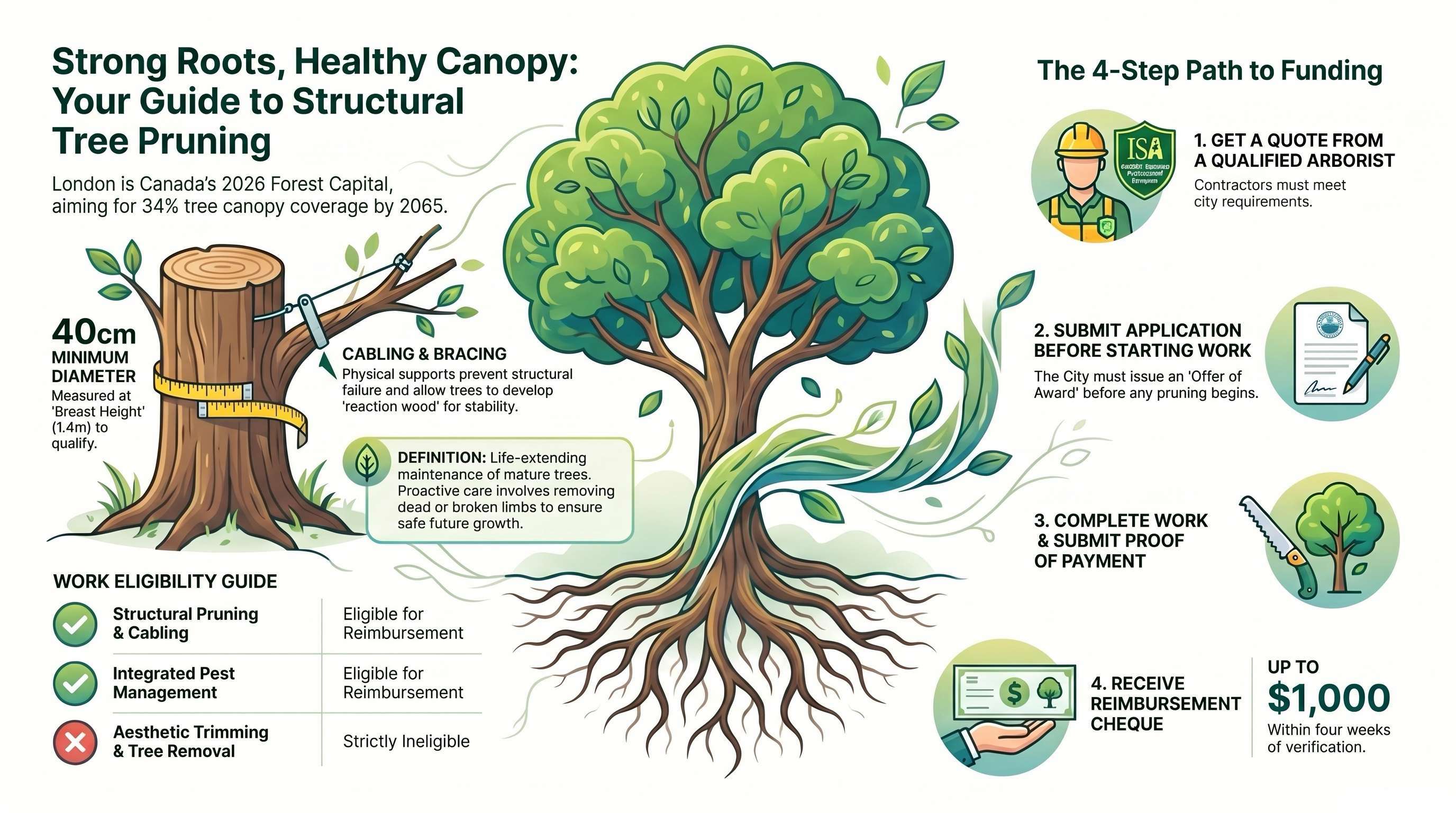
Structural Pruning Funding Guide
A visual overview of eligible maintenance, the 40cm DBH threshold, the arborist quote requirement, and the path to reimbursement.
Structural Pruning FAQ
Common questions about pruning eligibility, arborist requirements, Oak timing, and reimbursement.
What is structural tree pruning, and how is it different from basic trimming?
Structural tree pruning is a highly targeted arboricultural practice focused on improving the health, stability, and longevity of a mature tree. It involves the strategic removal of dead, cracked, or broken limbs, and pruning branches to improve the tree's overall architecture to ensure safe, adequate growth in future years. For veteran trees in their late stages of life, it can also include specialized pruning techniques that mimic natural decline. This is fundamentally different from basic aesthetic trimming or hedge shaping, which provides no biological or structural benefit to the tree and is strictly ineligible for municipal funding.
Does the City of London pay for structural tree pruning?
Yes. Through the 2026 Tree Canopy Conservation Program (TCCP), the City of London provides eligible property owners with a cash-back reimbursement of up to $1,000 per qualifying tree for proactive, life-extending maintenance, which heavily features structural pruning. This is designed as a reimbursement model, meaning you must first pay your approved arborist and submit a zero-balance invoice before the City mails you a cheque.
What trees qualify for the structural pruning grant?
To be eligible, the tree must be privately owned and have a minimum Diameter at Breast Height (DBH) of 40 centimeters. The program is incredibly accessible: there are absolutely no income limits, lot size minimums, or property value restrictions. Even non-resident owners, landlords, and real estate investors managing rental portfolios are fully eligible to apply.
Can I use a general landscaper or utility arborist for the pruning?
No, using an unqualified contractor will result in your grant application being automatically rejected. The City of London maintains strict professional gatekeeping for this program. All quoting and pruning must be completed by a recognized "qualified arborist," which includes professionals certified by the International Society of Arboriculture (ISA), the American Society of Consulting Arborists (ASCA), or Registered Professional Foresters (RPFs). Utility arborists, who focus on aggressive clearance near power lines, are specifically excluded from this conservation program.
I have an Oak tree that needs pruning. Are there special rules?
Yes. Due to the severe ecological threat posed by the Oak Wilt pathogen, the City of London strictly prohibits the pruning of Oak trees during the warmer months. All approved arboricultural work on Oak trees must be deferred to their winter dormancy period between November and March. To incentivize homeowners to comply with this vital ecological quarantine, the City suggests that Oak tree applications may actually be eligible for higher funding amounts. Homeowners should secure an upfront quote immediately to join an approved arborist's winter waitlist.
Can I use the grant to prune a tree if the City ordered me to fix a safety concern?
No. If you have been issued a municipal compliance order, such as an order to abate a safety concern under the Property Standards By-law, you cannot use the TCCP grant to pay for that required work. The grant is designed to incentivize proactive conservation.
Can I use the funds to remove the tree instead of pruning it?
Absolutely not. The explicit and sole goal of the program is mature canopy conservation, and the grant cannot be utilized for tree removals under any circumstances. Furthermore, if your tree has a DBH of 50 centimeters or greater, it is legally classified as a "Distinctive Tree". The unauthorized injury or destruction of a Distinctive Tree without a strict, expensive municipal removal permit carries severe fines. Structural pruning allows you to mitigate safety hazards and protect your property while getting paid by the municipality to safely preserve the tree.
Ready to Protect Your Canopy?
Our ISA Certified arborists specialize in structural care for London's unique urban forest.
Check Your Address for a Grant