Tree Cabling & Bracing
Mechanical support systems designed to protect your home and extend the life of your mature canopy.
What is Cabling & Bracing?
Unlike traditional pruning, cabling and bracing are supplemental support systems. They don't remove wood; instead, they provide physical reinforcement to trees with structural defects like codominant stems or heavy, overextended limbs.
Why it's a "Must-Have" for London Homes:
- Storm Protection: Prevents limbs from splitting during ice storms.
- Property Safety: Keeps heavy branches from falling on roofs or power lines.
- Tree Health: Allows the tree to safely develop "reaction wood" over time.
Cabling System Snapshot
A qualified arborist may recommend support hardware when mature limbs or co-dominant stems create a preventable failure risk.
- Stabilizes weak unions without removing the canopy.
- Reduces movement during wind, ice, and storm load.
- Quote details can be reviewed for TCCP reimbursement fit.
$1,000 reimbursement may apply after City review.
How the $1,000 Grant Applies
The Tree Canopy Conservation Program (TCCP) explicitly covers dynamic and static cabling systems. Because these systems are often expensive (ranging from $600 to $1,500), the municipal rebate can offset nearly the entire cost of installation.
Dynamic Cabling
Uses high-strength synthetic ropes that allow for natural tree movement while preventing catastrophic failure.
Steel Bracing
Threaded steel rods installed through a split or weak crotch to provide rigid mechanical support.
Cabling, Bracing & City Grants at a Glance
A visual summary of structural support, DBH eligibility, qualified arborist requirements, and the $1,000 reimbursement cap.
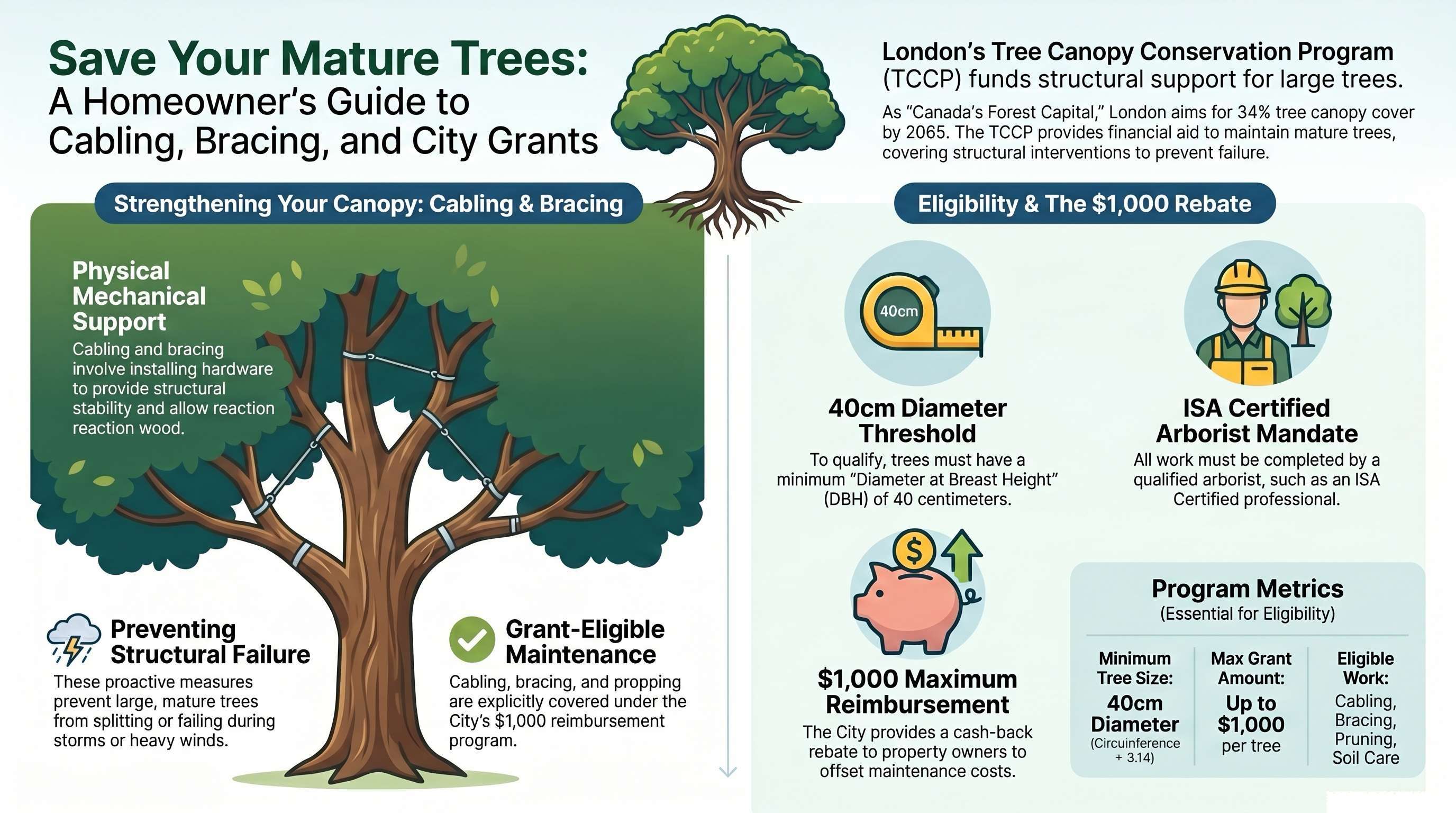
Cabling & Bracing FAQ
Key grant and arborist requirements for structural tree support in London.
What are tree cabling, bracing, and propping?
Tree cabling, bracing, and propping are highly effective arboricultural approaches used to provide physical mechanical support to mature trees. These structural support systems are designed to prevent structural or catastrophic failure, such as a massive old tree splitting and falling onto your roof, while safely allowing the tree to develop "reaction wood" that grows to support the tree's changing structural needs.
Does the City of London cover the cost of tree cabling and bracing?
Yes. Through the 2026 Tree Canopy Conservation Program (TCCP), the City of London actively funds proactive, life-extending tree maintenance, which specifically includes the installation of structural cables and braces. Eligible property owners can receive a cash-back reimbursement of up to $1,000 per qualifying tree for this work.
Which trees qualify for cabling and bracing under the municipal grant?
To be eligible for the funding, the tree requiring structural support must be privately owned and have a minimum Diameter at Breast Height (DBH) of 40 centimeters. There are absolutely no income limits, lot size minimums, or property value restrictions to access this funding, and you do not even need to physically reside at the property to apply.
Can any landscaping company install these support systems?
No. The City of London maintains strict professional gatekeeping. To qualify for the reimbursement, all quoting and installation of physical support systems must be completed by a "qualified arborist". This includes professionals certified by the International Society of Arboriculture (ISA), the American Society of Consulting Arborists (ASCA), or Registered Professional Foresters (RPFs). General landscapers and utility arborists are specifically excluded from this program.
Can I get reimbursed if I already paid to have my tree cabled?
No. Retrospective applications for arboricultural work that has already been completed are automatically disqualified from the program. You are legally required to get an upfront quote from an approved arborist, submit it to the City, and wait for a formal "Offer of Award" before any work can commence.
Why should I cable my mature tree instead of just removing it?
The explicit goal of the TCCP is mature canopy conservation, extending the life of London's largest trees and deferring their removal for as long as possible. Furthermore, if your tree has a DBH of 50 centimeters or more, it is classified under the Tree Protection By-law as a "Distinctive Tree". Removing a Distinctive Tree requires a strict, expensive permit, and unauthorized removal carries severe municipal fines. Cabling and bracing allow you to secure the structural safety of your property while getting paid up to $1,000 by the municipality to preserve the tree.
Don't Wait for a Split
If your tree has a V-shaped crotch or heavy limbs over your house, it's a prime candidate for cabling.
Check Your Address for a Grant